 thebravewritingcompany@gmail.com
| Topic |
|---|
| Introduction to Implantation Bleeding vs Period |
| What Is Implantation Bleeding? |
| How Implantation Happens |
| When Implantation Bleeding Occurs |
| What Is a Period? |
| Menstrual Cycle Explained |
| Hormonal Changes in Period |
| Key Differences Between Implantation Bleeding and Period |
| Color Differences |
| Flow Differences |
| Duration Differences |
| Pain and Cramping |
| 10 Powerful Signs to Identify the Difference |
| Timing: Implantation vs Menstrual Cycle |
| Symptoms Comparison Table |
| Causes of Implantation Bleeding |
| When to Take a Pregnancy Test |
| When to See a Doctor |
| Common Myths and Misconceptions |
| FAQs |
| Conclusion |
Introduction to Implantation Bleeding vs Period
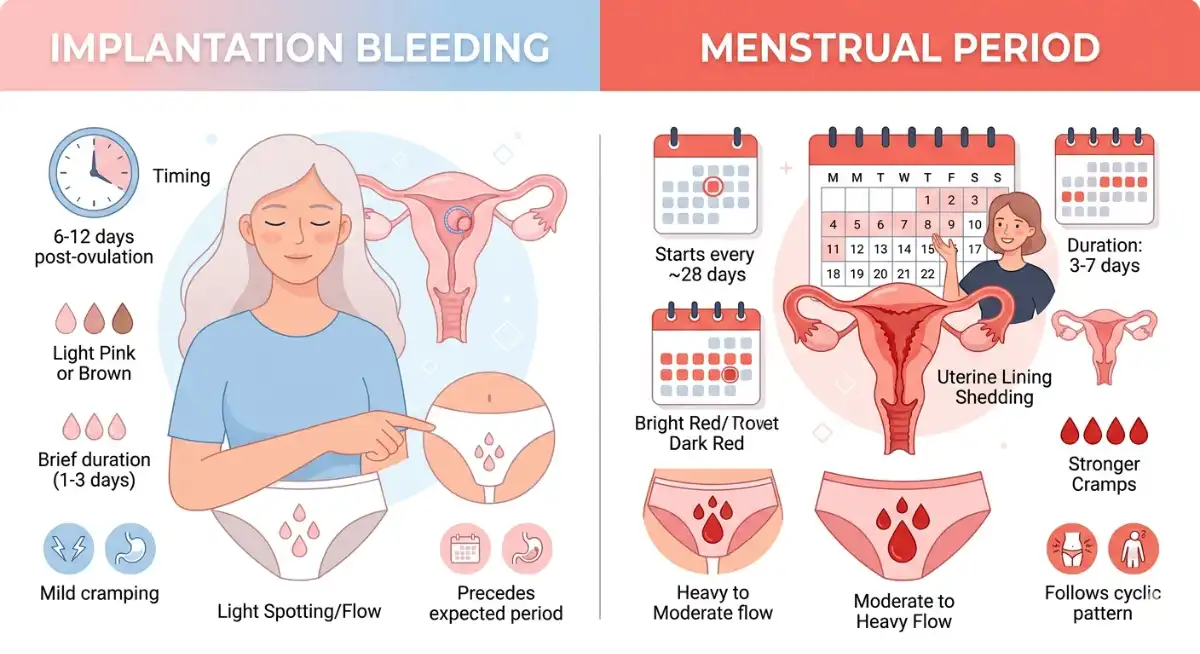
Understanding the key differences between implantation bleeding and period can be confusing, especially for women trying to conceive. Many women mistake one for the other because both involve vaginal bleeding. However, the causes, timing, and symptoms differ significantly.
In simple terms, implantation bleeding occurs when a fertilized egg attaches to the uterus, while a period is the shedding of the uterine lining when pregnancy doesn’t happen.
Let’s break it down step-by-step so you can clearly identify what your body is telling you.
What Is Implantation Bleeding?
Implantation bleeding is a light spotting that happens in early pregnancy. It occurs when the fertilized egg attaches itself to the uterine lining.
How Implantation Happens
After ovulation, if sperm fertilizes the egg, the embryo travels to the uterus. Around 6–12 days later, it implants into the uterine wall. This process may cause slight bleeding.
When Implantation Bleeding Occurs
- Typically occurs 6–12 days after ovulation
- Happens before your expected period
- Usually appears as light spotting
What Is a Period?
A period is part of the menstrual cycle. It happens when pregnancy does not occur, and the uterus sheds its lining.
Menstrual Cycle Explained
- Average cycle: 21–35 days
- Period duration: 3–7 days
- Flow: Light to heavy
Hormonal Changes in Period
Hormones like estrogen and progesterone drop, triggering the uterine lining to shed, resulting in menstrual bleeding.
Key Differences Between Implantation Bleeding and Period
Let’s explore the most important key differences between implantation bleeding and period that help distinguish them.
1. Color Differences
- Implantation bleeding: Light pink or brown
- Period: Bright red to dark red
2. Flow Differences
- Implantation: Very light spotting
- Period: Moderate to heavy flow
3. Duration Differences
- Implantation: Few hours to 2 days
- Period: 3–7 days
4. Pain and Cramping
- Implantation: Mild cramps
- Period: Strong cramps, especially on day 1–2
10 Powerful Signs to Identify the Difference
Here are 10 powerful signs to identify the key differences between implantation bleeding and period:
- Timing – Implantation occurs earlier than a period
- Flow – Implantation is spotting, not flow
- Color – Lighter shades vs deep red
- Clots – No clots in implantation
- Duration – Short vs longer bleeding
- Cramping – Mild vs intense
- Breast tenderness – More common in implantation
- Fatigue – Early pregnancy symptom
- Nausea – Rare in periods, common in pregnancy
- Basal temperature – Stays high in pregnancy
Timing: Implantation vs Menstrual Cycle
Timing is one of the strongest indicators.
| Event | Timeline |
|---|---|
| Ovulation | Day 14 (average cycle) |
| Implantation | Day 20–26 |
| Period | Day 28 |
If bleeding occurs earlier than expected, it could be implantation.
Symptoms Comparison Table
| Symptom | Implantation Bleeding | Period |
|---|---|---|
| Color | Pink/Brown | Red |
| Flow | Light spotting | Heavy |
| Duration | 1–2 days | 3–7 days |
| Cramping | Mild | Strong |
| Clots | No | Yes |
| Hormones | Pregnancy hormones rise | Hormones drop |
Causes of Implantation Bleeding
Implantation bleeding happens due to:
- Embryo attaching to uterine wall
- Breaking of small blood vessels
- Hormonal shifts in early pregnancy
It’s completely normal and not harmful.
When to Take a Pregnancy Test
If you suspect implantation bleeding:
- Wait 3–5 days after spotting
- Use a morning urine sample
- For best accuracy, test after missed period
When to See a Doctor
Consult a doctor if:
- Bleeding is heavy like a period
- Severe abdominal pain occurs
- Dizziness or weakness appears
- Bleeding lasts more than 3 days
These could indicate other conditions.
Common Myths and Misconceptions
Let’s clear up some myths:
- Myth: Implantation bleeding happens in all pregnancies
Fact: Only about 20–30% women experience it - Myth: Heavy bleeding can be implantation
Fact: Implantation is always light - Myth: You can confirm pregnancy with spotting
Fact: Only a pregnancy test confirms it
FAQs
1. Can implantation bleeding be heavy?
No, implantation bleeding is usually very light and never heavy like a period.
2. How many days does implantation bleeding last?
It typically lasts a few hours to 2 days.
3. Can implantation bleeding have clots?
No, clots are usually associated with periods, not implantation.
4. Is cramping normal during implantation?
Yes, mild cramping is common but much less intense than period cramps.
5. Can I be pregnant even if I had bleeding?
Yes, implantation bleeding can occur in early pregnancy.
6. What color is implantation bleeding?
It is usually light pink or brown, not bright red.
Conclusion
Understanding the key differences between implantation bleeding and period is essential for identifying early pregnancy signs. While both may seem similar, factors like timing, flow, color, and symptoms make a clear distinction.
If you notice light spotting before your expected period, along with early pregnancy symptoms, it might be implantation bleeding. However, always confirm with a pregnancy test for accurate results.
Being aware of your body’s signals empowers you to make informed decisions and seek medical advice when necessary.
🌐 External Resource
For more detailed medical insights, visit:
https://www.mayoclinic.org
Post-Article Message:
If you found this helpful, feel free to ask for a personalized symptom check or pregnancy timeline based on your cycle.